RS-485 is a robust, half-duplex differential communication interface, standardized under TIA-485-A, ANSI/TIA/EIA-485, or TIA/EIA-485. Being half-duplex, traditional RS-485 systems require active direction switching between transmission and reception. Typically, engineers must use GPIO pins from a microcontroller to toggle the /RE (Receiver Enable) and DE (Driver Enable) pins. However, writing time-critical toggling code in firmware can be complex and error-prone, occasionally leading to bus contention. To bypass software complexity, some designers build additional discrete circuits on the PCB to trigger auto-direction switching, which unfortunately increases board size and system cost.
Introducing the COS13487 with Integrated Direction Control
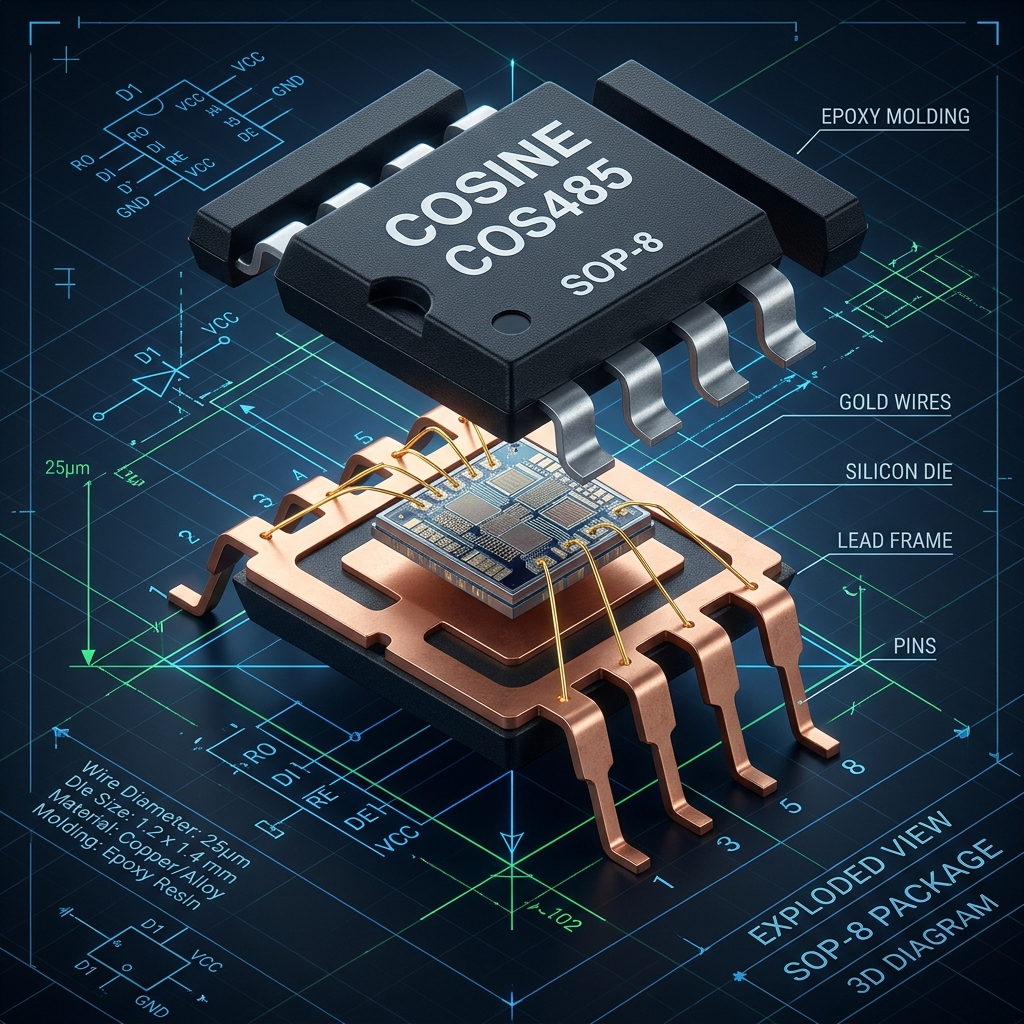
To address this design challenge, Cosine Nanoelectronics has introduced the COS13487, a half-duplex RS-485 transceiver featuring integrated automatic direction control and hot-swap capabilities. The hot-swap function eliminates transient bus glitches during power-up or hot-plugging. Structurally, the pinout of the COS13487 is highly compatible with the standard COS485 transceiver, with the only variation being pin 3.
- Pin 3 (SHDN): Shutdown pin. Set high for normal operation; pull low to enter low-power shutdown mode.
- Pin 2 (CTRL): Auto-direction control pin. Pull low for standard receive mode; set high to enable automatic direction control mode. In this mode, the internal state machine automatically controls the driver and receiver states without any firmware configuration or external components.
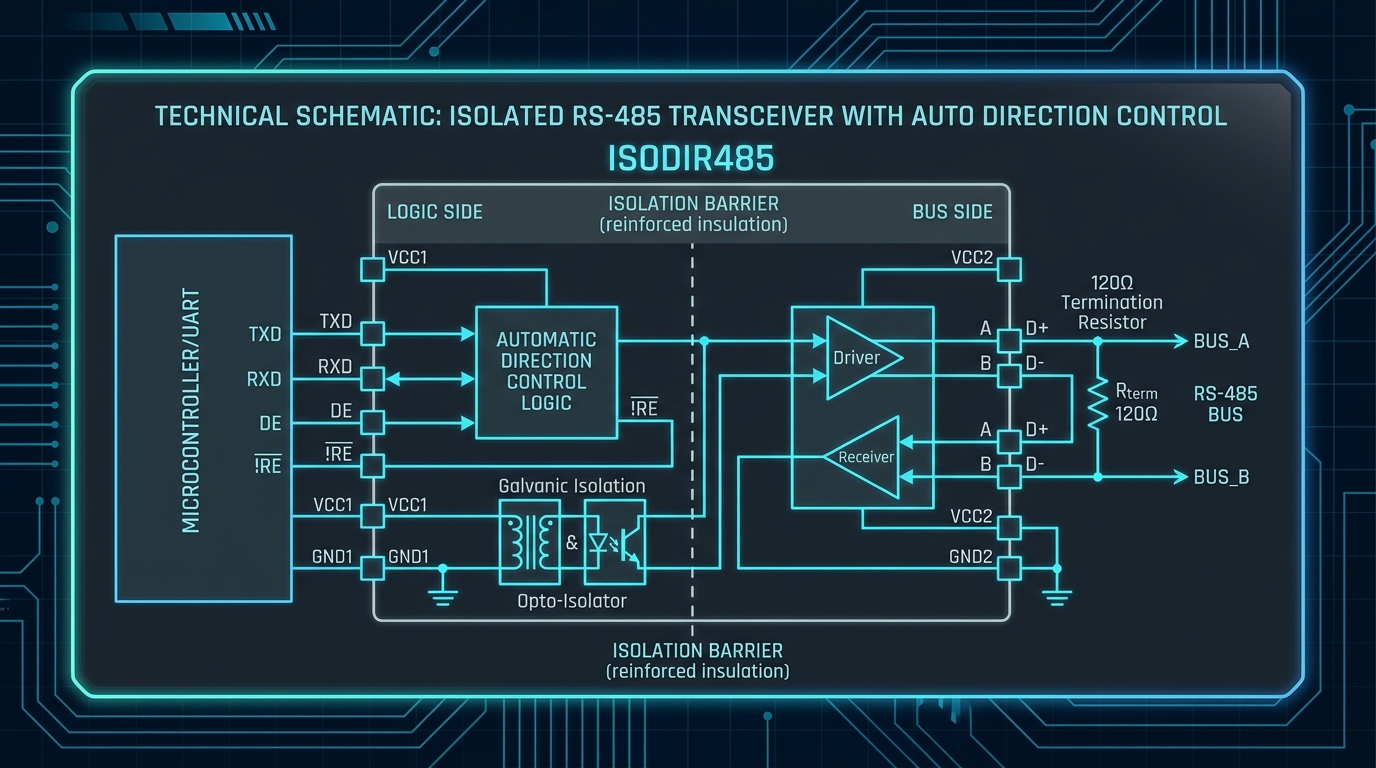
Typical Isolated RS-485 Application Circuit
A typical application circuit is shown below, illustrating a fully isolated RS-485 interface using the COS13487. By pulling both pin 2 and pin 3 high, the chip is placed in auto-direction control mode. All other pins are wired identically to standard transceivers.
By using the COS13487, designers can reduce the number of high-speed isolator lines, requiring only two optocouplers to achieve complete electrical isolation of the TX and RX channels. This makes design layouts significantly more efficient and cost-effective.