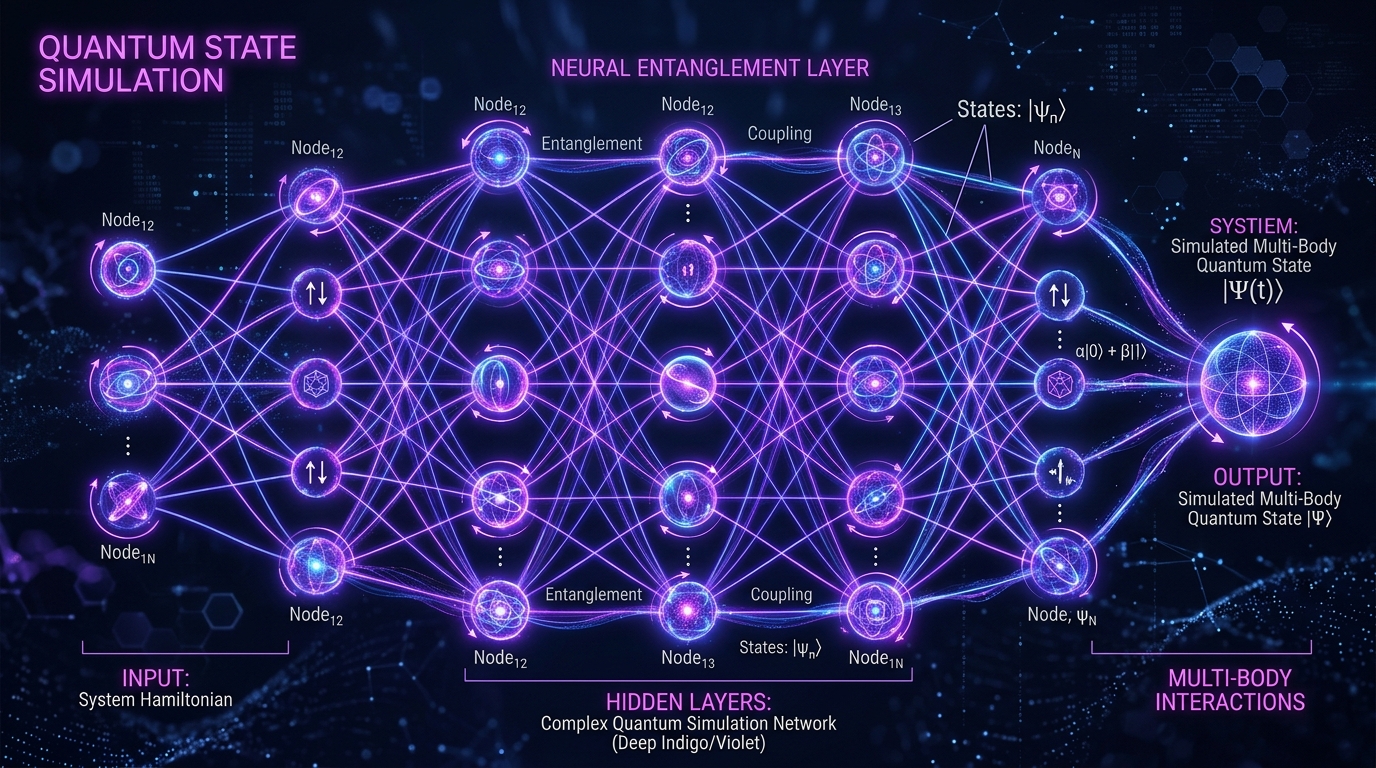
Artificial intelligence and quantum computing represent two of the most exciting frontiers in modern science. However, unlike the widespread commercial deployment of AI, quantum computing still faces massive physical and mathematical challenges. Recently, physicists have developed an innovative computational method using artificial neural networks to simulate open quantum systems, representing a major breakthrough in solving several long-standing problems in quantum information science.
The new method, independently developed by an international team of physicists from EPFL (Switzerland), France, the UK, and the USA, has been published as a series of papers in the prestigious journal Physical Review Letters. It addresses the fundamental bottleneck of quantum simulation: the state space of a quantum system grows exponentially with the number of interacting particles, quickly rendering classical supercomputer simulations impossible.
Auto-Calibration of Quantum Density Matrices
The complexity is further amplified when dealing with "open" quantum systems, which interact with and are perturbed by their external environments. Since almost all real-world experimental quantum hardware platforms are open systems, finding efficient simulation tools is crucial for evaluating environmental noise and decoherence.
To overcome this, the research team combined advancements in machine learning with variational Quantum Monte Carlo (QMC) algorithms. By training a neural network to represent the multi-body density matrix of the quantum states, they bypassed the exponential memory barrier. The neural network acts as a variational ansatz, which is optimized using a stochastic reconfiguration scheme to integrate the quantum master equation.
Broad Implications for Quantum Hardware
This variational neural-network approach enables physicists to predict the steady-state properties of open quantum systems across arbitrary geometries. Professor Vincenzo Savona, director of the Laboratory of Theoretical Physics of Nanosystems at EPFL, noted: "This method represents a highly versatile tool that will become a standard benchmark for simulating complex quantum networks and assessing the impact of environmental noise on next-generation quantum computing hardware."